Manufacturers of complex products are under mounting pressure to move faster, quote more accurately, and adapt to rising customer expectations, all while managing aging systems and ongoing geopolitical uncertainty. Over the past year, many organizations have responded by increasing software investment and accelerating technology adoption.
The data is clear: manufacturers are spending more on software and digital tools than they were just a year ago.
For leaders, this reflects a broad recognition that digital transformation is no longer optional. Investments are being driven by goals such as improving productivity, accelerating growth, strengthening security, and enabling greater automation across the enterprise.
Yet the report also shows a critical counterbalance to this optimism.
In other words, while budgets and ambition are increasing, workforce readiness is not keeping pace.
This mismatch is becoming a defining challenge for manufacturers of complex products, where technology adoption often touches quoting, engineering, production, and downstream fulfillment all at once. Without the right skills and systems in place, even well-funded initiatives risk stalling before they deliver value.
What’s holding manufacturers back is not interest, but execution.
Across the broader technology stack, leaders cite familiar obstacles:
These challenges are especially pronounced for manufacturers managing complex, engineer-to-order products where inconsistent product data, disconnected systems, and manual processes compound risk and slow decision-making.
Against this backdrop, CPQ (Configure, Price, Quote) software has emerged as a critical area of investment. It has quietly become the system that holds modern manufacturing workflows together, especially for complex, engineer‑to‑order products.
Our report shows that manufacturers are using CPQ to directly address some of their most persistent operational challenges:
For organizations selling complex products, CPQ often sits at the intersection of sales, engineering, and manufacturing. When it works well, it reduces quoting cycle times, minimizes errors, and improves coordination across teams. When it doesn’t, it quickly exposes deeper issues with data quality and system integration.
Manufacturers are prioritizing CPQ capabilities that reduce friction and manual effort, including:
Despite widespread adoption, CPQ implementation is not without obstacles.
Manufacturers report that their top CPQ-specific challenge is integration with existing systems (32%). This is understandable: CPQ, by its nature, depends on accurate product data and seamless system connectivity. Without integration, organizations risk recreating the same silos and manual handoffs they were trying to eliminate.
When CPQ is implemented effectively, however, the payoff is clear. Manufacturers report benefits such as:
For operations leaders, the takeaway is not simply to adopt CPQ, but rather to treat it as part of a broader digital foundation that includes data governance, integration planning, and workforce enablement.
The Smart Manufacturing 2026 findings point to a pivotal moment for manufacturers of complex products.
Technology investment is accelerating. Adoption plans are ambitious. But the organizations that will pull ahead are those that balance speed with readiness. They will not only invest in new tools, but also in the skills, data, and integration strategies required to make those tools work.
Manufacturers that address skills gaps, modernize integration approaches, and embrace CPQ will be better positioned to turn technology investment into measurable operational gains.
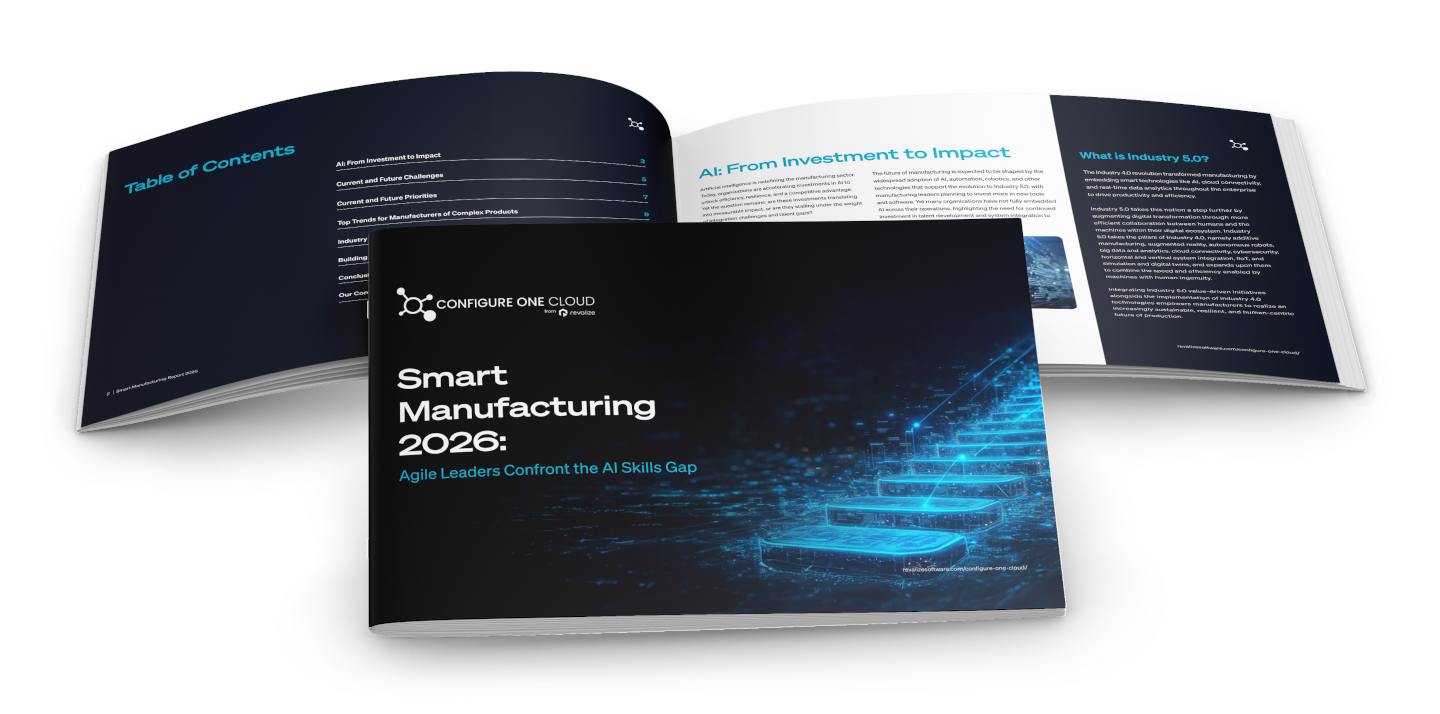
Smart Manufacturing 2026: Agile Leaders Confront the AI Skills Gap is based on a survey of 500 CPQ, PLM, and engineering software decision-makers at manufacturing companies with 100+ employees in the United States and DACH regions.