REPORT: Agile Leaders Confront the AI Skills Gap Learn more
Main Menu
Smart Manufacturing 2026
How Agile Leaders Are Confronting the AI Skills Gap
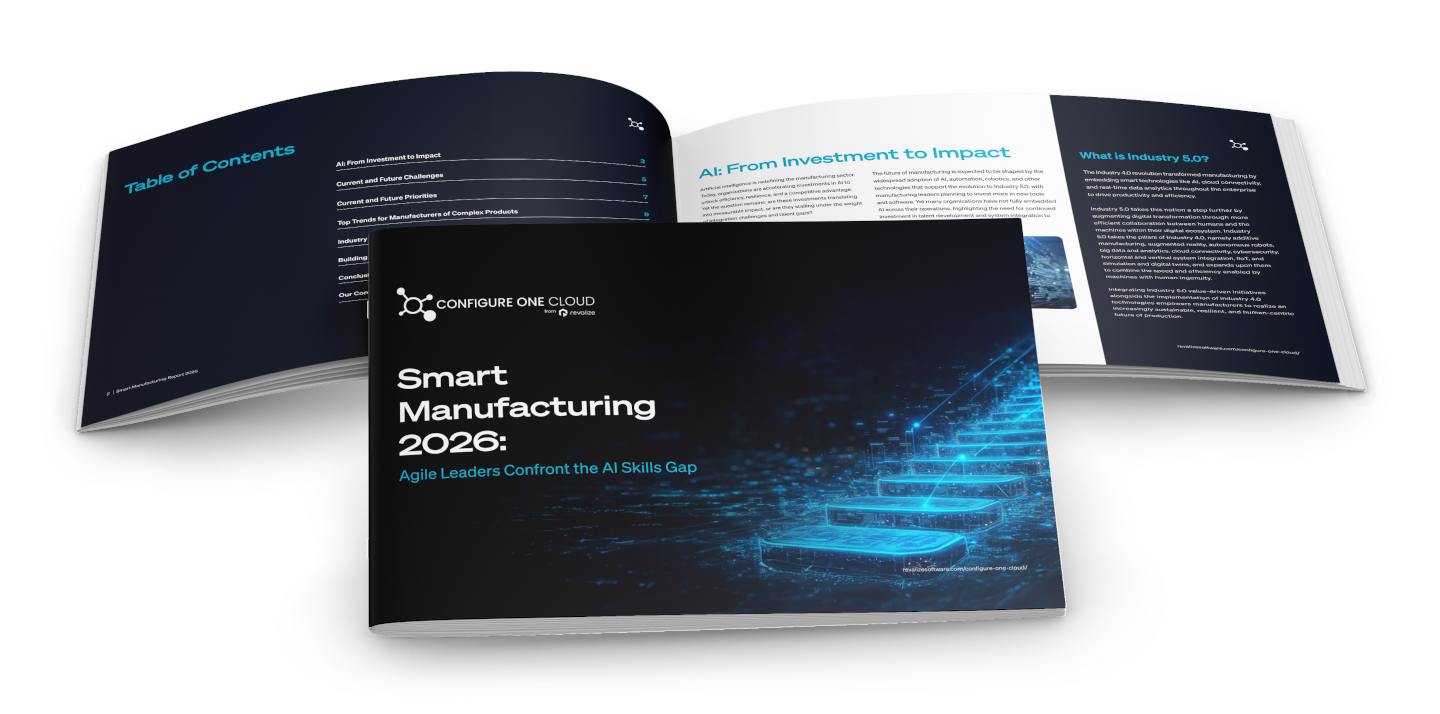
93% of manufacturers will adopt new technologies during 2026. Download our new report to discover if these investments will have a real impact, or wither under integration challenges and talent gaps.
AI continues to reshape manufacturing, creating new opportunities for efficiency, growth, and competitive advantage. Yet, as organizations adopt AI-enabled automation, tools for more efficient and accurate quoting, product configuration platforms, and other solutions, many still face challenges with legacy system integration, data quality, and workforce readiness.
CPQ adoption is increasingly important, with manufacturers primarily using it for:
43%
CRM
integration
41%
product
configuration
39%
pricing
management
The Smart Manufacturing 2026 Report reveals how today’s most agile organizations are navigating these challenges while building a stronger digital foundation for the future. This data-rich research provides an insider look at the technologies manufacturers are prioritizing, where talent gaps persist, and how businesses are using purpose-built solutions to reduce complexity and improve speed and accuracy when calculating pricing and generating proposals.
Complete the form to access the Smart Manufacturing 2026 Report and see what’s shaping tomorrow’s manufacturing strategies.
To understand these trends, we surveyed 500 software decision makers across North America and DACH. Here’s what we discovered:
93% of manufacturers plan to adopt new technologies in the next 12 months, including AI-powered quality control and CPQ platforms.
CPQ adoption is increasingly important, with manufacturers primarily using it for CRM integration (43%), product configuration (41%), and pricing management (39%).
Cloud‑based CPQ is gaining momentum, driven by benefits like faster deployment of new technologies (37%), improved team collaboration (27%), and real‑time data access (23%).
Whether you’re responsible for operations, product development, engineering, or digital transformation, this report highlights where the industry is trending and how to stay ahead.
Today, organizations are accelerating investments in AI to unlock efficiency, resilience, and a competitive advantage. Yet the question remains: are these investments translating into measurable impact, or are they stalling under the weight of integration challenges and talent gaps?