As data centers proliferate and become more crucial to the world’s technological infrastructure, cooling systems have become an increasingly strategic asset. This is especially true as infrastructure scales from hyperscale campuses to edge deployments and the fluid systems build to keep them operating grow exponentially more complex.
However, design and operations teams often rely on fragmented tools and siloed processes that compromise performance, sustainability, and uptime. In this article, we share a few technology-related best practices that help turn fluid cooling system design from a reactive necessity into a proactive driver of efficiency, resilience, and long-term value.
One of the most persistent challenges in data center development is the breakdown between disciplines. Design teams hand off to commissioning teams, who hand off to operations, often with incomplete documentation or mismatched expectations.
This disjointed approach invites manual data entry errors, cross-functional miscommunications, and process inefficiencies at multiple stages.
It’s also unnecessarily expensive. As industry research notes, 70–80% of a project’s lifecycle cost is committed by the end of the conceptual design stage.i
For example: instead of redrawing or reinterpreting fluid system logic at every phase, teams should work from a shared, intuitive model that mirrors field operation conditions. From early concept through operations, a continuously evolving digital fluid model support visual communication, training, and more informed decision-making across project phases.
Centralizing this design data in a single model enables multiple stakeholders, each with different priorities, to remain aligned and working toward the same goal.
Not all engineering tools are built for fluid systems. And few serve both design and operations teams with the accuracy and flexibility required to balance performance, redundancy, and uptime.
If you’re designing fluid cooling systems for data centers, look for a design solution that is built for the job. Look for a tool that models how fluid systems behave under real-world operating conditions, not just static geometry or theoretical calculations.
With this type of simulation, engineers can run the full loop under operating conditions, mapping factors like pump curves, valve logic, elevation deltas, and component-specific logic in a single environment. This clarity transforms redundancy planning (like N+1 or N+2) from theory into engineering certainty.
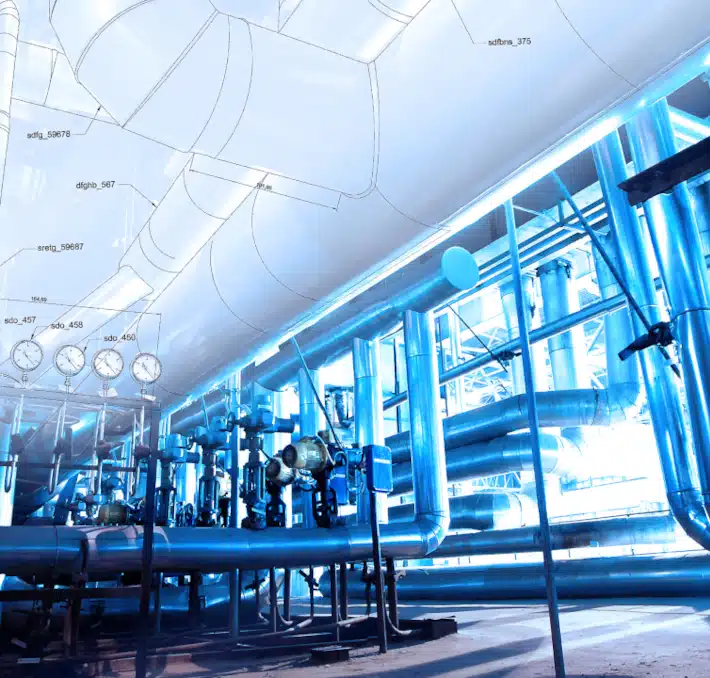
Unlike CAD tools or spreadsheets (which typically lack dynamic simulation capabilities), an engineering design tool built for fluid systems can create a functional digital twin replica that helps teams anticipate problems, plan upgrades, and operate with clarity.
The tool should also be intuitive to use, so even non-specialists can visualize flows, pressures, and equipment performance. That makes cross-functional communication simpler, especially when decisions involve multiple disciplines or outside stakeholders.
As rack densities climb and liquid cooling becomes standard, fluid systems are growing more complex and more central to performance, energy efficiency, and sustainability goals. Meeting these demands requires more than static plans.
Engineering teams need tools that enable dynamic modeling, digital twin replicas, and real-world scenario testing so they can align design intent with operational reality. With the right solution, your model evolves along with your cooling system, capturing decisions, documenting changes, and keeping the entire team aligned over time. That means operators can simulate upgrades, validate performance, and sign off on CapEx knowing the design is ready for tomorrow’s heat loads and ESG targets.
As data center designs become more complex, engineers should look for a fluid system design tool that is capable of simulating system behaviors, validating decisions, and streamlining commissioning by reducing surprises and uncertainties.
i Saravi, M., Newnes, A., Mileham, R., & Goh, Y.M. (2008). Estimating cost at the conceptual design stage to optimize design in terms of performance and cost. In R. Curran et al. (eds.) Collaborative product and service life cycle management for a sustainable world (pp. 123-130). Springer, London.
ii Data Center Knowledge. (2025, Jan. 17). A Guide to Data Center Water Usage Effectiveness (WUE) and Best Practices. informa. https://www.datacenterknowledge.com/cooling/a-guide-to-data-center-water-usage-effectiveness-wue-and-best-practices.
iii International Organization for Standardization. (2022). ISO/IEC 30134-8:2022. https://www.iso.org/standard/77691.html.
iv European Commission. Energy Efficiency Directive. https://energy.ec.europa.eu/topics/energy-efficiency/energy-efficiency-targets-directive-and-rules/energy-efficiency-directive_en.