

REPORT: Agile Leaders Confront the AI Skills Gap Learn more

Smart Manufacturing 2026: Why Technology Investment Is Rising Faster Than Readiness

Two workers in safety vests and goggles operate machinery, with digital data and interface graphics overlaid, in a modern industrial setting.
Manufacturers of complex products are entering 2026 with clear momentum. Software budgets are increasing, new technologies are being evaluated, and many engineering teams are working to modernize how product data moves from design through production and beyond.
But beneath that optimism is a quieter, more complicated reality: investing in technology is easier than operationalizing it.

New research from PRO.FILE’s Smart Manufacturing 2026 study reveals that manufacturers are moving quickly toward advanced digital capabilities, yet many are doing so while facing growing gaps in skills, integration, and data readiness. For engineering leaders and IT decision-makers, this tension is becoming one of the defining challenges of modern manufacturing.

Execution Risks Are Growing as Technology Investment Accelerates

The topline numbers paint a confident picture. According to the survey:
This signals a manufacturing sector that understands the stakes. Leaders are prioritizing automation, analytics, and connected platforms to improve productivity, resilience, and speed to market.
However, the same research reveals a critical counterweight to that confidence.

When asked about workforce needs, 36% of manufacturers identified AI skills as their most urgent gap (the top response overall and even higher among U.S.-based teams). This highlights a fundamental challenge: while tools are advancing rapidly, the human and operational systems required to support them are struggling to keep pace.

For organizations managing complex product structures and lifecycles, engineering change, and multi-system environments, this gap has real consequences. Without the right skills and foundations in place, new technology investments risk becoming isolated pilots rather than scalable improvements.
This tension becomes even more pronounced when manufacturers narrow their focus from enterprise-wide transformation to the strategies and systems that support product development itself.
Next, let’s look at one specific strategy (product lifecycle management, or PLM) and the systems that enable it (product data management, or PDM).

Smart Manufacturing Report Winter 2026

Get your copy of the Smart Manufacturing 2026 report to learn how manufacturing leaders are confronting the AI skills gap, integration complexities, and other operational challenges. Download today!
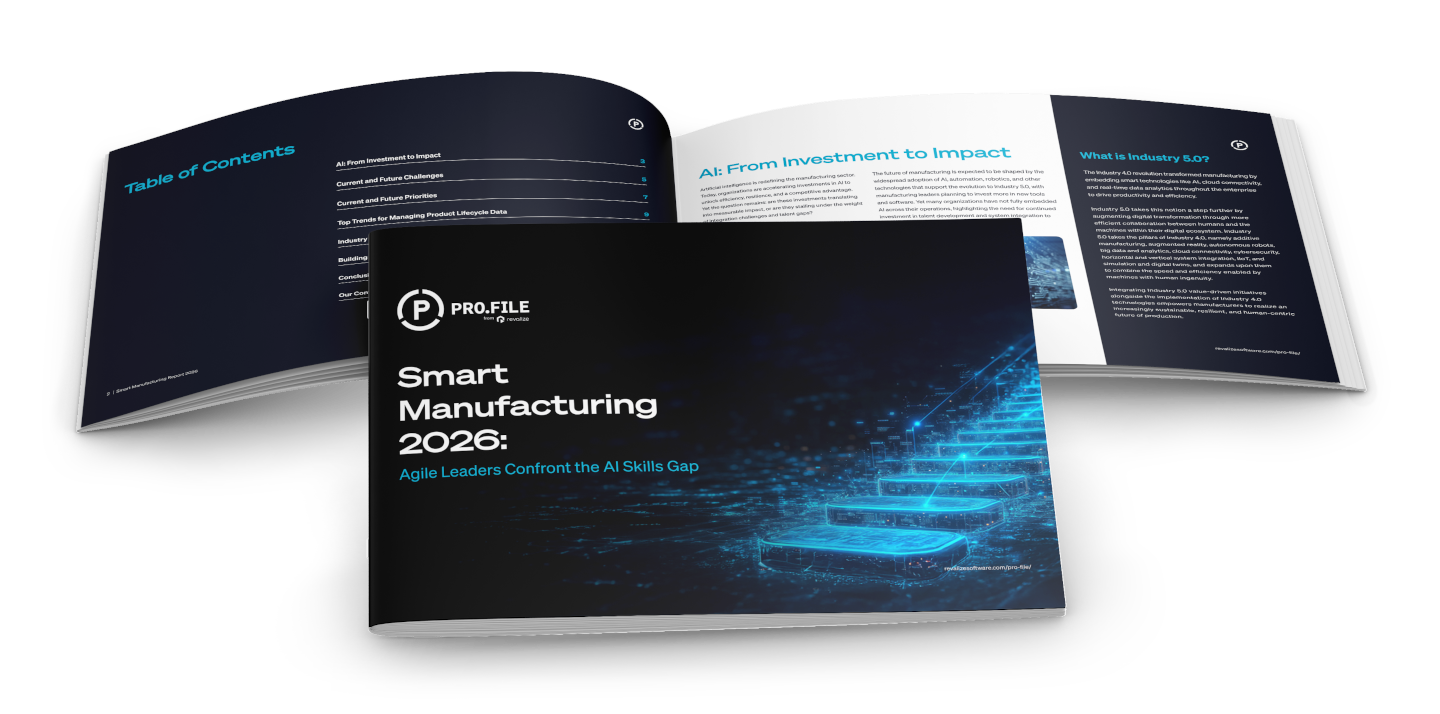
Two open booklets titled Smart Manufacturing 2026: Agile Leaders Confront the AI Skills Gap, displaying the cover, table of contents, and an interior page.

Product Lifecycle Management vs. Product Data Management

Let’s quickly define some terms. In practice, product lifecycle management (PLM) should be understood as a management strategy, not a single tool. It defines how product information, processes, and decisions are governed across the entire lifecycle, from early design through manufacturing, service, and retirement.

Executing that strategy requires a robust technology foundation. This is where a product data management (PDM) platform plays a critical role, serving as the operational backbone that structures, secures, and connects product data within day‑to‑day engineering workflows.

Our research shows that PLM (via robust PDM) is increasingly central to digital manufacturing strategies. Manufacturing leaders report that their top PLM use cases include:
These are not experimental edge cases. They are core workflows that determine how efficiently organizations manage product complexity, coordinate cross-functional teams, and maintain data accuracy across the lifecycle.

The PLM Adoption Gap: Integration, Data, and Trust

Despite these ambitions, our research highlights persistent barriers that slow adoption and dilute ROI:
These challenges point to a recurring issue: many PLM initiatives struggle not because the strategy is flawed, but because the product data foundation is incomplete. Integration, migration, and data certification problems often arise when there is no single system responsible for governing product data at the source.

This is the role of a PDM platform like PRO.FILE. PDM systems focus on the product development phase of the lifecycle, integrating CAD and other CAx tools, connecting to ERP, and enforcing version control, access rights, and change processes. When PDM is treated as a foundational layer rather than an afterthought, PLM strategies are far more likely to scale beyond isolated teams and deliver consistent value across the organization.

Why Skills Matter as Much as Systems

The AI skills gap identified in the report helps explain why many PLM initiatives stall short of their potential.
This gap is felt most acutely at the point where strategy meets execution. Advanced PLM capabilities rely on engineers and IT teams understanding how product data is structured, governed, and shared through the systems they use every day. Without a well‑implemented PDM platform anchoring those workflows, even highly capable teams are forced to compensate with manual work, disconnected tools, and informal processes.
This challenge is further compounded for organizations managing complex products. As PDM/PLM environments expand, the cost of poor integration or unclear ownership rises, impacting engineering efficiency, compliance, and time to market.

What Manufacturing Leaders Should Take Away

The findings from Smart Manufacturing 2026 point to a clear conclusion: technology investment alone is no longer enough.
PLM is not just another system in the stack. It is a strategic approach to managing product complexity across the enterprise. Its success depends on having a reliable PDM platform underneath it, ensuring that product data remains accurate, traceable, and usable from design through delivery.

Explore the Full Findings

This article highlights only a portion of the insights uncovered in PRO.FILE’s Smart Manufacturing 2026 research. The full report explores:

Smart Manufacturing Report Winter 2026

Get your copy of the Smart Manufacturing 2026 report to learn how manufacturing leaders are confronting the AI skills gap, integration complexities, and other operational challenges. Download today!

Two open booklets titled Smart Manufacturing 2026: Agile Leaders Confront the AI Skills Gap, displaying the cover, table of contents, and an interior page.

About the Research

Smart Manufacturing 2026: Agile Leaders Confront the AI Skills Gap is based on a survey of 500 CPQ, PLM, and engineering software decision-makers at manufacturing companies with 100+ employees in the United States and DACH regions.

About PRO.FILE

Backed by over 40 years of expertise, PRO.FILE from Revalize is a recognized leader in product lifecycle management (PLM), product data management (PDM), and technical document management (DMStec). Our PRO.FILE platform connects product data across every phase—empowering manufacturers to maximize efficiency from design to delivery.